
Before the School Year: Remember to Detect Legionella in Boarding School and Gym Showers
In recent months, numerous episodes of Legionella contamination have been reported by the media. Recently, a new building at 1325 Jerome Ave., which houses a Bronx charter school and low-income apartments, was identified as the source of the Highbridge Legionnaires’ outbreak—resulting in 30 cases of Legionnaires’ disease, 28 hospitalizations, and two fatalities. In West Orange, New Jersey, Legionella bacteria were discovered in multiple schools, with all but three schools testing positive. Similarly, in the United Kingdom, Legionella was detected at Milton Keynes School (source) and at Glebe Primary School in West London (more information). These incidents underscore the ongoing risk of Legionella contamination in educational institutions and highlight the critical importance of regular monitoring, maintenance, and prompt remediation to ensure the safety of students and staff.
Are Educational Institutions Affected by the Legionella Risk?
All establishments receiving the public (ERP), including educational institutions, are required to maintain a health logbook ensuring the traceability of all operations performed on hot water systems : work, maintenance, treatments, and analyses.
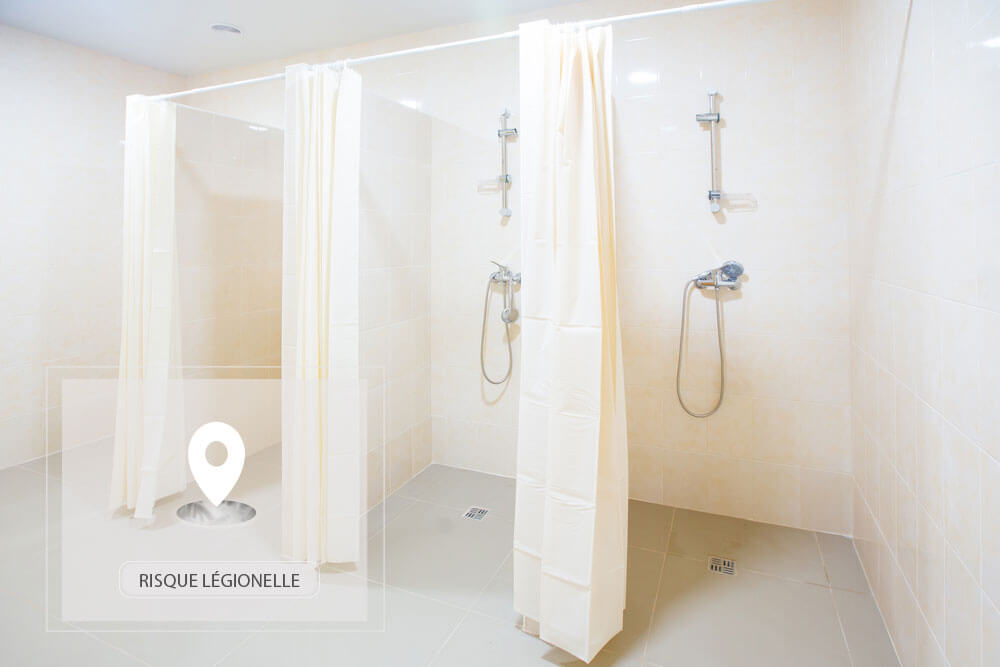
Showers are one of the major vectors of Legionella infection in humans. Educational institutions present a significant risk in the locker rooms of their sports facilities and their boarding schools.
In the event of network contamination, it is necessary to resort to thermal shocks and massive injection of biocides.
The installation of filters on showerheads, or even the total suspension of access to showers, is sometimes necessary.
Once the bacteria have colonized the water networks, it is indeed difficult to remove them. The expenses for disinfectant products and overheating to eradicate them can represent a significant bill.
Prevention as the Best Ally Against Legionella
A colony of Legionella can double in size between 20 minutes and 4 hours. This means that in a very short time, proliferation can exceed authorized thresholds.
Thus, if analyses are not performed frequently, the 10-day period required to receive a diagnosis from a NF T90-431 certified laboratory will not allow for optimal responsiveness in case of contamination.
Anticipate the risk associated with installations and verify the effectiveness of any treatments accessible to everyone.
Self-control kits are now marketed to perform these tests on-site, independently and confidentially. This will allow, for example, preparation for a regulatory inspection.
Finally, the regular maintenance and cleaning of all equipment capable of projecting microdroplets is essential. Scale deposits and corrosion residues favoring bacterial proliferation.
At the Start of the School Year, Educational Institutions Must Undergo a Regulatory Analysis of Water Networks
During the summer holidays, the hot water networks of boarding schools and sports facilities in educational institutions are not used.
This leads to water stagnation in the pipes, which is a factor for Legionella proliferation.
Additionally, summer temperatures cause a rise in water temperatures, including in the cold water network.
Therefore, the law stipulates that the annual regulatory analysis of hot and cold water networks according to the NF T90-431 standard must be carried out just before the September school start.
This is indeed essential for institutions to prove the absence of Legionella in order to be authorized to welcome students.
In this context, self-control texsts conducted at least every two weeks during the summer will allow, in the event of an infection, sufficient time to treat the networks before the mandatory analysis. This ensures the ability to guarantee public access from the start of the school year.
Read our Other Articles
Risk Management Strategy for Legionella in Domestic Hot Water
Risk Management Strategy for Legionella in Domestic Hot WaterTo prevent contamination by Legionella pneumophila in domestic hot water systems, regular testing, temperature control, and rapid-response strategies are essential. Here’s a practical and proactive...
Infectious risk posed by Legionella pneumophila outside of serogroup 1 in hospitals
Infectious risk posed by Legionella pneumophila outside of serogroup 1 in hospitalsDespite existing risk control policies and awareness by health authorities, the diagnosis of legionellosis is still far from systematic.Because hospitalized patients are particularly...
Pontiac Fever, Symptoms, Diagnosis, and Treatments
Pontiac Fever, Symptoms, Diagnosis, and TreatmentsWhat is Pontiac fever? What is the difference between it and Legionnaire’s disease? Why is it called that? How does it manifest? And most importantly, how can it be avoided? C4Hydro revisits this illness. What is...